
In-Store Analytics
Understand what actually happens at the counter, across every store, in language your operations team can act on.
Thanks to everyone who visited us at NACS!
PRODUCT LAUNCH PREVIEW
A preview of Pythia's next generation of checkout hardware and retail insights.

Silent product animation showing Pythia Pro checkout displays with employee service scores, a customer greeting, face-rating choices, and a service-rating screen.
Built for Retail Chains
Built to grow with you
Is annual turnover above 100% in your stores?
How many new employees are still with you after their first 60 days?
When the team keeps changing, training becomes a constant reset. Even a strong program can lose consistency across stores, managers, and shifts. Greetings get skipped. Promotions are explained differently. New employees improvise when they are unsure. Those small gaps can become uneven service and missed sales opportunities.
Pythia Pro adds an ongoing feedback loop after onboarding. By analyzing checkout interactions, it can surface recurring patterns that managers may want to address with clearer direction, refresher training, or recognition for what is working.
Establish clear expectations for greetings, promotions, policies, and customer service.
Pythia Pro can surface recurring patterns from checkout interactions for managers to review.
Give managers focused areas for refresher training, clearer direction, or recognition.
Built by a retail operator
In my stores, most training happened on the job. Managers taught differently, and employees often trained the next new hire. Within a few months, someone still developing their own habits could become another employee's source of truth.
They were doing their best. The system lacked a consistent feedback loop. I built Pythia to help managers review what happens after training, reinforce shared expectations, and recognize what is working.
Founder, Pythia Scorecard
Interact with our capabilities below to see exactly how Pythia translates in-store sensor data into actionable workflows.
Explore how Pythia Pro turns checkout interactions into practical insights for coaching, staffing, customer understanding, and promotional performance.
Understand what actually happens at the counter, across every store, in language your operations team can act on.
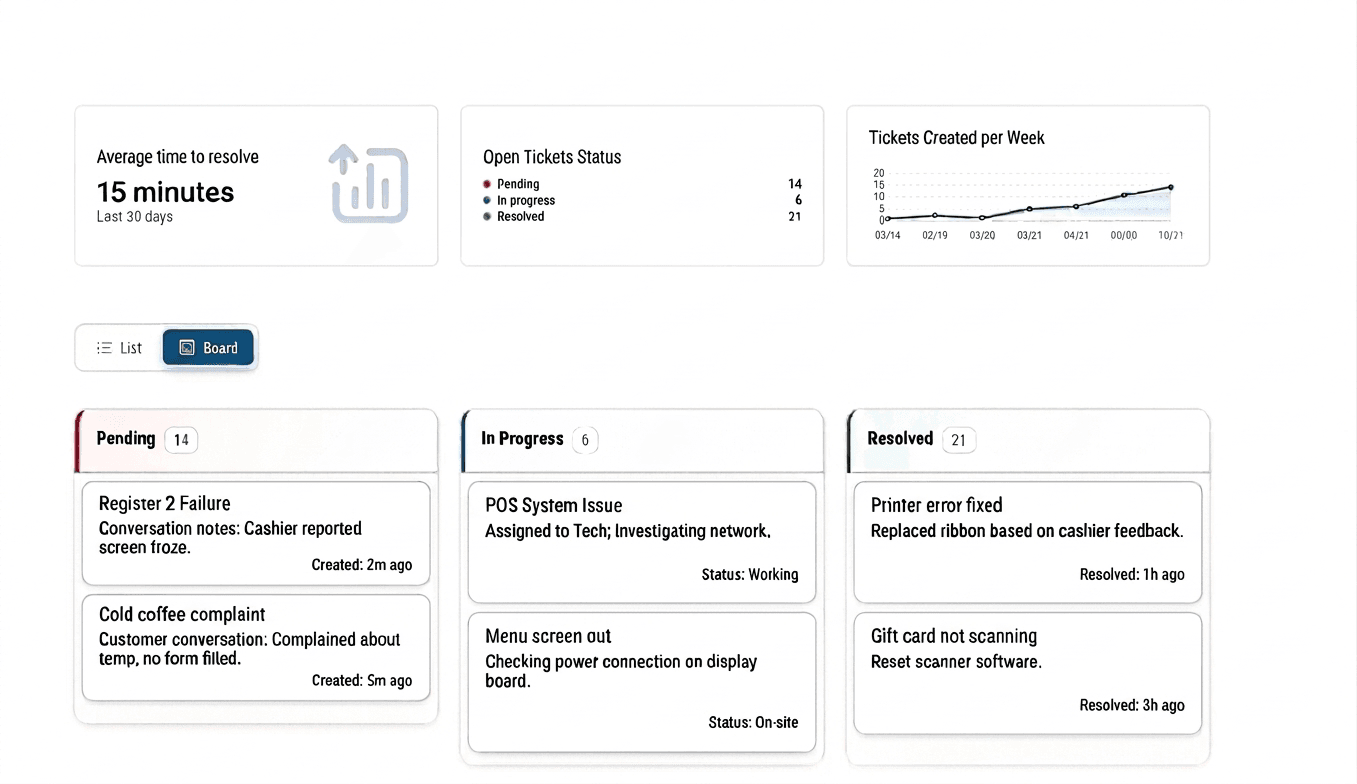
When Pythia identifies a relevant issue in a checkout transcription, its AI Ticket Agent can draft a work order and route it to the appropriate manager or maintenance team.
Use local audio and video AI to surface structured operational insights for owners and managers.
See how service, upsell behavior, and friction vary by location so you can coach stores like a top-performing region.
Across a three-store convenience-retail group, Pythia analyzed 47,659 checkout conversations in April and partial May 2026. Employee sentiment improved at every location, lifting the conversation-weighted network score from 47.8% to 62.0%.
Higher employee sentiment network-wide
47.8% to 62.0% across all 3 stores
Employee sentiment rebound at two stores
36.7% to 58.6%, conversation-weighted
Lower complaint rate at one store
2.42 to 1.57 per 1,000 conversations
Higher customer sentiment at the same store
33.1% to 36.1% (+3.0 points)
Source: anonymized three-store customer performance scorecard, April-May 2026. April is a full month. May is partial through May 29, May 21, and May 28 by location. Network and two-store sentiment figures are conversation-weighted, and complaint rates are normalized per 1,000 conversations. These figures show observed operational change and do not establish Pythia as the cause or prove revenue impact.
As a multi-unit convenience store operator, we need to keep a close eye on store-level details, both issues and opportunities. More often than not, these surface during checkout conversations between customers and cashiers. Pythia Scorecard uses AI to capture, flag, and categorize these interactions, allowing our supervisors to easily understand the situation and act quickly. Success in our business is built on getting the details right, and Pythia is a vital tool that lets us oversee our stores 100% of the time, even when management isn't on the floor. As a company leader, since implementing Pythia, my overall confidence in our operations has improved. It gives me the flexibility to oversee the business at a high level, while still allowing me to easily drill down into the details whenever necessary. Pythia is quickly becoming an invaluable tool for ensuring our standards are met every single day.
As a multi-site fuel retail and convenience operator with nearly 40 locations across the Chicago suburbs, knowing what's happening at each site without being physically present is one of our biggest operational challenges. Pythia Scorecard gives us visibility into what's happening at the store level. Customer interactions and team behavior are at the forefront of the feedback loop. For us, the biggest win has been catching early warning signs before they become bigger issues. When a store's culture starts to drift or a team dynamic starts to shift, Pythia flags it early enough for us to step in and course correct before it impacts the customer experience or our numbers. In a business where we can't be everywhere at once, Pythia gives us the confidence that our standards are being upheld. Not just when a manager is watching
First, we spend 15 minutes learning about your stores and priorities. If there is a fit, we schedule a separate 30-minute demo tailored to your needs.
You should leave knowing
Whether a closer look at Pythia makes sense and what your demo should focus on.
Understand your stores, operating priorities, and the problems you want to solve.
Tell us where service, coaching, or daily operations need the most attention.
Discuss what your managers need to know and how they would use those insights.
Discuss your goals, store setup, and questions about the device, data, or privacy.
If there is a fit, agree on a separate 30-minute demo and the priorities it should cover.
Start with a 15-minute discovery call about your stores and priorities. If there is a fit, we will schedule a separate 30-minute demo.
See how Pythia Pro turns audio, video, and optional POS transaction data into practical insights for your stores.
Whether you oversee a full network of locations or run a flagship store, Pythia gives you a clear, shared view of what happens at the counter every day.
Persona
Get a network-level view of where stores are leaking revenue, burning out great people, or introducing friction that never shows up in standard reports.
Persona
See exactly how conversations are going in your store so you can coach with confidence, celebrate wins, and fix issues before they turn into lost customers.
Help managers move from identifying an issue to taking action. Pythia Pro surfaces relevant details from checkout interactions to support follow-up and resolution.
Pythia can identify mentions of equipment failures, customer complaints, and operational issues in checkout transcriptions.
The AI agent can draft a ticket, organize the relevant details, and route it to the appropriate team for review.
Low friction. Immediate value.
Employee-facing and customer-facing sensors capture audio and video at each point of sale.
Local AI analyzes these interactions to surface customer feedback, service patterns, and coaching opportunities. Optional POS transaction-log linking adds sales context.
Owners and managers review the insights to guide coaching, staffing, promotions, and store operations.
Timely insights for fast-paced retail environments.
Capture service details that impact drive-thru and counter speed.
Understand shopper friction and staff efficiency across departments.
Track fit-room assistance and closing ratios at the register.
Review potential guest-sentiment and recommendation patterns.
Pythia Pro uses employee-facing and customer-facing sensors positioned at the checkout. Local AI processes audio and video to generate insights for authorized owners and managers. Customer counts reflect people observed at the register, not everyone who enters the store.
An anonymized three-store review of 47,659 checkout conversations, with sentiment changes, complaint rates and clear limits on what the results show.
Compare voice and manual issue reporting using completeness, accuracy, staff effort and follow-through in your own stores.
Learn how Pythia Scorecard can turn relevant point-of-sale transcriptions into draft tickets for maintenance and coaching workflows.
Everything you need to know about Pythia Scorecard.
You can start with one location. Pythia Scorecard works for a single store, a regional group, or a large chain. Most operators begin with one or two sites, validate the impact on coaching and sales, and then expand deployment across additional locations.
Pythia Pro includes an employee-facing sensor and a customer-facing sensor at each point of sale. Local AI processes audio and video from these sensors to capture insights across customer transactions.
Corporate leaders, regional operators, and store managers can all access relevant insights. The platform presents a network-wide view for leadership and a store-level view for local teams. That structure helps decision makers compare performance across locations while giving managers practical coaching signals they can use every day.
Pythia Pro uses patent-pending technology designed to reduce background noise and focus on what matters most to operators: the interaction between the employee and the customer. Results can vary with store conditions and sensor placement.
Mystery shops provide occasional snapshots. Pythia is designed to give operators a more continuous view of transcribed checkout interactions across shifts and stores, providing additional context for coaching, consistency, and inside-sales performance.
Pythia can evaluate transcribed checkout interactions against defined service and sales behaviors. The platform organizes those observations into performance signals, trend reporting, and potential coaching opportunities for owners and managers to review.
Pythia can identify mentions of maintenance issues, service breakdowns, and customer complaints in checkout transcriptions. Relevant details can then be organized and routed into the appropriate workflow for a manager or maintenance team to review.
Pythia Pro uses employee-facing and customer-facing sensors positioned at the checkout. Local AI processes audio and video to generate insights for authorized owners and managers. Customer counts reflect people observed at the register, not everyone who enters the store.
Yes. Pythia Pro can optionally link with your POS transaction logs to combine checkout interaction insights with sales data for more detailed business intelligence reporting.
We are happy to help!
Across an anonymized three-store convenience-retail group, employee sentiment improved at every location from April to partial May, lifting the conversation-weighted network score by 29.8%. See what Pythia could surface across your stores.
Setup
Plug In and Connect
Connectivity
Wi-Fi & Ethernet
Tell us about your stores in a 15-minute discovery call. If there is a fit, we will schedule a separate 30-minute demo.